What if the Galactic Empire in Star Wars was… actually competent? What if the rebels didn’t have plot armor or the force? What if the galactic war didn’t end with the cinematic death of Palpatine?
Japanese novelist Yoshiki Tanaka’s “Legend of the Galactic Heroes” answers those questions.
The foundations of the series include battles between fleets of spaceships numbering in the tens of thousands, with casualties reaching well into the multi-millions, and a war measured in planets. The series reflects on the uncensored cost of war and examines the social, political, and economic consequences that create the many intricate folds and details that allow the story to become more than what it might be taken at face value.
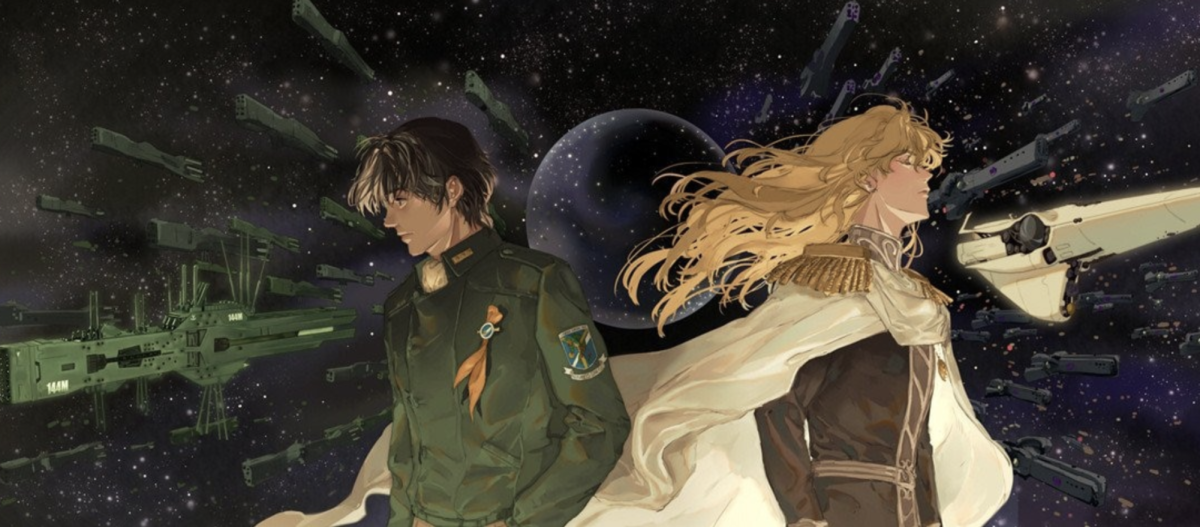
However, these battles are not what differentiate “Legend of a Galactic Heroes” from other books. The 10-book series covers an interstellar conflict between the autocratic Galactic Empire and the democratic Free Planets Alliance (FPA) in the year 3110 AD. Each is led by its respective heroes: Reinhard Von Lohengramm for the Empire and Yang Wen Li for the FPA. Their development is central to the plot and helps humanize the largely bureaucratic and mathematical nature of the war and politics.
While it may be easy to generalize the story as a stand-off between democracy and dictatorship or between good and evil, the book never states this outright; in fact, the book doesn’t want a clear moral distinction between the two forces. Tanaka describes the Empire as an antiquated aristocracy well past its due date. The political landscape is bleak, with lethargic nobles more interested in glorifying their lifestyles than actually governing their estates. On the other hand, the FPA is merely a publicity stunt for innately corrupt politicians who abuse the definition of democracy and freedom to gain votes and retain their political seats without a care for the millions dying for the very values that they dogmatize.
The book makes it clear that in war, neither side is truly good or evil. While the Empire fights against perceived rebels and traitors, the FPA resists what they think are oppressors and imperialists who deny liberties. The book purposely omits a concrete conclusion to which side is right to highlight the ambiguity of morality and perspective in war.
It is this intergalactic stage that protagonists Reinhard Von Lohgengramm and Yang Wen Li are thrust into. Reinhard is an ambitious and exceedingly talented young noble who seeks to dismantle the current aristocratic order that humiliated him and enslaved his sister. While he is a capable ruler and many consider his reign to be significantly better than anything the previous nobility could offer, his rule is ultimately derived from emotion rather than true benevolence.
Opposing Reinhard is Yang Wen Li, a 30-year-old FPA Sub-lieutenant who later rises to the rank of Admiral. He is an equally brilliant individual who seeks nothing but an early retirement to a secluded area of the galaxy to explore his options of becoming an amateur historian. However, his dreams are cut short by the war, and he is constantly forced to compromise his pacifist ideals with the violent realities of war.
Oftentimes, it is in his monologues that the reader will be provided the most in-depth complications with the complexities and meaninglessness of war. He is highly critical of both sides of the war and, while a staunch defender of democracy, does not hesitate to criticize the politicians and give credit to the workings of the Empire. He asks the reader: Is a corrupt democracy better than a benevolent dictatorship? This is only one of the many questions that he asks not only to himself, but to the reader, that is intentionally left unanswered.
“Legend of Galactic Heroes” is truly a book that rewards patient readers. While some may find the lack of conclusion frustrating, especially regarding the morality and justifications of the war and politics, that is the core message of the series. Beyond the glamorous orations of the politicians and leaders that attempt to romanticize the sacrifices of the soldiers and the reason for fighting, war is ambiguous, and the reality is a bleak arithmetic that has no true solution. I believe that no book better encapsulates this theme than “Legend of the Galactic Heroes”.