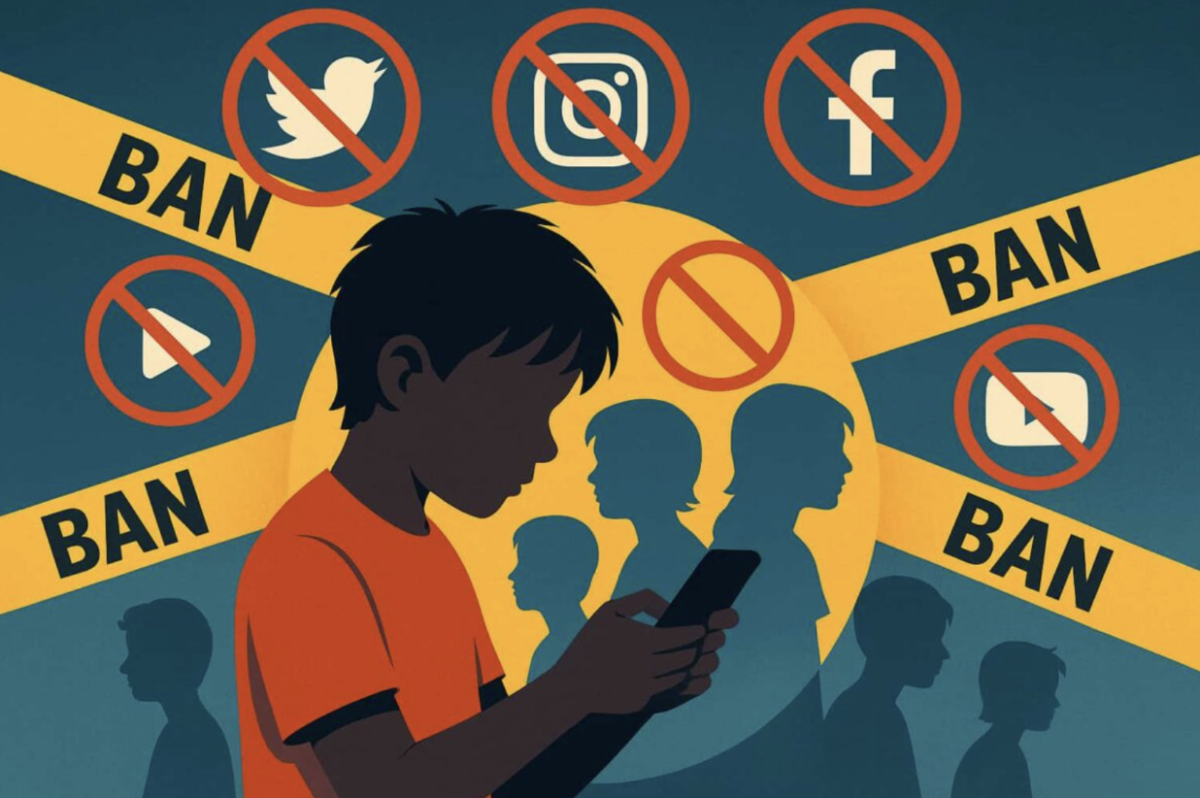
Growing concerns about the impacts of addictive algorithms on children’s mental health have culminated in Australia implementing a first-ever nationwide social media ban for children under 16 on Dec. 10, 2025. On March 28, Indonesia joined the move by banning social media for children under 16, and more than two dozen countries have also proposed plans to restrict children’s access to social media over the past few months.
These policies come amid growing concerns over social media’s impact on children’s mental health and safety. The Australian government argues that the risks of social media, such as cyberbullying and exposure to harmful content, outweigh the benefits. They also stated that the ban would reduce the negative impact of social media’s “design features that encourage [young people] to spend more time on screens, while also serving up content that can harm their health and wellbeing.”
As of April, Australia and Indonesia are the only countries that have implemented the policy. In Australia, 10 social media platforms were covered by the ban, including Facebook, Instagram, Snapchat, YouTube, Threads, and Reddit. They excluded WhatsApp, YouTube Kids, Discord, Roblox, and other online games from the restriction, finding that these services did not sufficiently meet the three main criteria of a covered platform: having online social interaction as a sole or significant purpose, allowing interaction with other users, and allowing users to post material. Indonesia’s social media ban also covered major “high-risk” platforms like TikTok, Instagram, Facebook, YouTube, X, and Threads.
However, Australia and Indonesia are not acting in isolation; their decision reflects a broader global movement. Countries like Denmark and Greece have announced plans to activate similar restrictions in the following years. Other countries, including Spain, France, and the UK, are weighing or advancing legislation of their own. Support for stronger restrictions has also grown through public campaigns such as the UK’s Smartphone Free Childhood movement, whose co-founder, Daisy Greenwell, states that “despite the 13+ minimum age requirement for [most] social media, 51 percent of British children under 13 use it.”
One strength of Australia and Indonesia’s policies is that they place responsibility on social media companies rather than directly on children or parents. They penalize companies that fail to prevent under-16s from accessing their platforms, rather than penalizing children and parents who infringe the ban. This places accountability on companies that created and profit from these addictive systems in the first place.
The policy may be effective in a more limited sense: it can delay early exposure during a particularly vulnerable stage of development. The Australian government has framed the policy as a ‘delay to having accounts,’ not a permanent ban. They argue that delaying account access until 16 gives young people more time to build important skills and maturity, like impulse control and greater resilience to the harmful effects of social media, before entering digital spaces shaped by short-termism and addictive algorithms. Considering how many children begin using social media from a young age in recent generations, that delay could offer meaningful short-term protection.
Still, this approach has limitations in the long-term. A ban may temporarily reduce exposure, but it does not teach children how to navigate online spaces safely and responsibly. After the age of 16, they will gain access to social media anyway. Without stronger efforts to teach digital literacy and healthy social media consumption habits, merely postponing access will not prepare them to use these spaces well.
The deeper issue lies in the design of social media platforms themselves. These platforms are built around algorithms designed to capture attention, encourage dependence, and maximize engagement. As long as engagement is prioritized over well-being, children will remain at risk whenever they are eventually allowed on. Delaying access will not make those systems safer. Even adults often struggle to regulate their own social media use. Without education or guidance, expecting teenagers to suddenly manage these platforms responsibly is unrealistic.
At the same time, it is unrealistic to expect society to reverse its digital dependence or for big tech companies to willingly weaken their addictive systems that make their platforms so profitable. In that reality, one of the most practical responses is to strengthen people’s ability to self-regulate and engage with social media in healthier ways.
Whether this nationwide social media ban policy does more good than harm, then, depends on how governments use it. If these policies are used as a starting point for safer platform design and stronger digital education, the bans may serve a meaningful purpose. However, if governments mistake delayed access for a complete solution, the policy will fall short.
Given how common social media usage has become among children before they develop essential offline skills such as conversation and control, concerns about its harmful effects are valid. However, the real long-term solution requires making social media safer by design while also teaching young people how to use it critically and responsibly. Governments can pressure companies to reduce addictive features and strengthen protections for children, but parents should remain the children’s first source of guidance and digital education.