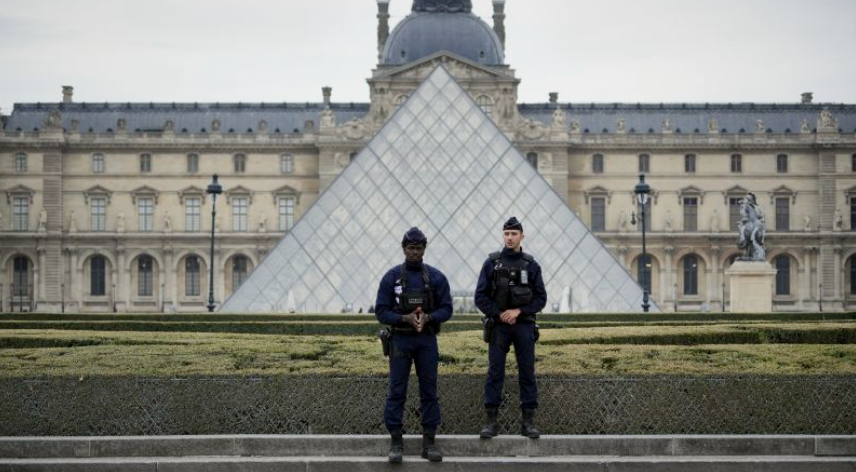
A daring jewelry theft at the Louvre Museum in Paris has left France in shock.
On Oct. 19, four thieves broke into the Apollo Gallery, the home to France’s royal jewelry collection, and escaped within minutes with treasures valued at over 1.4 trillion won (approximately $100 million).
Reportedly, the group used a stolen ladder truck to climb the museum’s outer wall along the Seine River. They then broke through a second-story window and shattered two high-security glass display cases to steal eight royal jewels before disappearing. The entire incident took only seven minutes, according to French investigators.
Among the stolen artifacts were an emerald-and-diamond necklace gifted by Napoleon I to Empress Marie-Louise, and a sapphire necklace once owned by Queen Marie-Amélie.
None of the pieces were insured, as the French Ministry of Culture explained that national treasures are typically covered by the state instead of private insurance due to the immense cost.
“It is concerning,” Hannah Ireland, AP Art teacher, said. “There is an assumption that these are high-security environments because of the value of the items they safeguard, but obviously, this case challenges that assumption. Sometimes museums display replicas of particularly valuable or fragile works, but the Louvre usually shows the originals, putting them at higher risk.”
The theft has raised serious questions about the museum’s security system. Despite being one of the most visited and heavily guarded museums in the world, the ease of the break-in suggests major flaws in its security infrastructure.
“It is a bit embarrassing for the Louvre at the moment,” Ms. Ireland said. “But it is not the first and will not be the last time a theft is carried out at a major art museum. To the public familiar with the topic or those who remember previous thefts, it is not especially surprising and fits with a long history of art theft.”
Authorities have since expanded their investigation team from 60 to 100 officers.
“I remember visiting the Louvre with my parents when I was young,” Dyne Kim (12), AP art student, said. “The Louvre has a long-lasting history that it almost feels untouchable. Hearing about the theft makes me realize how fragile even the most powerful symbols of art and culture can be. It’s a reminder that preserving history isn’t guaranteed.”
The investigation remains ongoing as French authorities continue their international search for the missing jewels. For now, the empty display cases in the Apollo Gallery stand as a haunting reminder of how even the most guarded treasures can vanish overnight.
“There have been many art heists throughout history; Edvard Munch’s The Scream, for example, has been stolen multiple times,” Ms. Ireland said. “These kinds of events always fascinate the public and live on in movies and pop culture, so I think there is an element of notoriety that is appealing to thieves. Upgrading security systems also has a cost, and institutions would need to have (and be willing to spend) the capital to improve security.”
Building on Ms. Ireland’s point about the public’s enduring fascination with art theft, excited spectators begin to parallel famous pop culture films to the daring heist.
“Movies like ‘The Bank Job’ or ‘Ocean’s Eleven’ make these crimes look fun and enchanting,” Yool Choi (12), media enthusiast, said. “But the reality is that art theft destroys culture and erases parts of history. This shows how the way things are portrayed in the media deeply influences public perception. Like in this case, media attention sometimes overshadows the seriousness of the crime.”