As summatives shape the rhythm of life at SIS, students naturally form strong opinions about the assessments they encounter. To understand how these preferences differ, Tiger Times Online conducted an instragram poll on Nov. 7, asking students which types of summatives they like the most and which they dread. The responses varied widely, demonstrating how students experience stress and engagement differently.
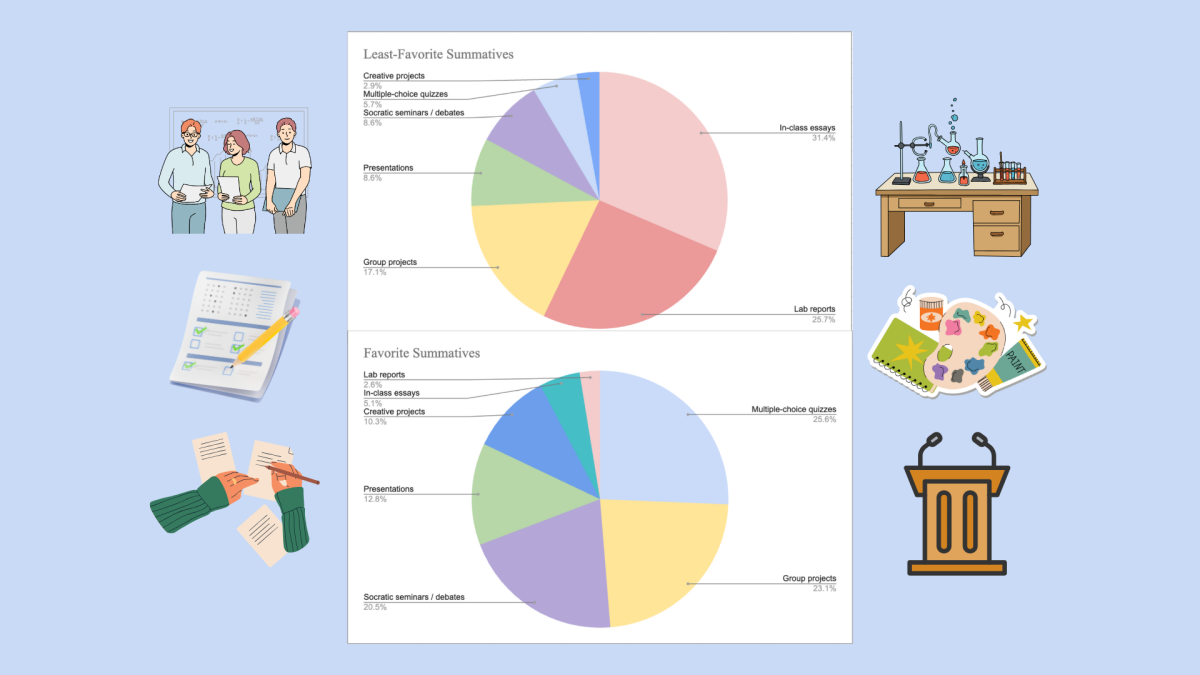
The poll shows that multiple-choice quizzes ranked as the most popular summative assessment, accounting for 25 percent of the 39 total favorite responses. Group projects followed closely at 23 percent, likely due to opportunities for collaboration, while Socratic seminars and debates accounted for 21 percent, reflecting students’ appreciation for open discussion. Presentations (13 percent) and creative projects (10 percent) fell into the mid-range of preference. Meanwhile, in-class essays (5 percent) and lab reports (3 percent) were the least commonly selected as favorites.
However, the same assessments that some students enjoy are the least preferred for others. In-class essays emerged as the most disliked summative assessment, accounting for 31 percent of the 35 least-favorite responses, as students often feel pressured by strict time limits and the challenge of producing analytical writing on the spot.
“I prefer MCQs the most,” Jun Yi (11), STEM-track student, said. “MCQs are straightforward, and you can make inferences since you are given the answer choices. On the other hand, in-class essays feel more intimidating because you have to start from a blank sheet, and there’s a time limit.”
Lab reports followed at 26 percent, with students citing the heavy workload and formatting requirements. Even group projects, despite being liked by many, were the least favorite for 17 percent of respondents, often due to uneven workload distribution.
“I personally do not prefer group projects because there would always be at least one person who does not do their work,” Alina Lee (11), student who has completed several group-based summatives this semester, said. “That makes the process much more stressful. You also cannot control your peers’ performance, so it feels like the outcome is not fully in your hands.”
Different subjects naturally lend themselves to different types of summatives. In classes where logical precision is the primary focus, teachers often rely solely on quizzes and tests to measure individual understanding, not only because they align with course content, but also because they mitigate concerns about fairness.
“Mathematics tends to be one of the disciplines that is most demanding in terms of students’ scores, ” Nathan Warkentin, Precalculus and AP Calculus BC teacher, said. “So, a lot of students feel a lot of pressure to get as high a grade as possible. Unfortunately, when you do not use an in-class summative to assess students’ work, the chances of them cheating are really high. There are very few assessments you can administer fairly without having students sit down and produce written work of logic and justification.”
Fairness also plays a role in why humanities teachers frequently adopt in-class essays. These assessments allow teachers to evaluate analytical thinking and writing under equal conditions.
“Students need to be able to express their thoughts in a more organized way and communicate deeper things,” Daniel Rogers, AP US history teacher, said. “When everyone writes in class, I get a clearer picture of what they actually understand.”
Naturally, there will always be tension between student preference and teacher intent. With preferences differing so widely, it is nearly impossible to design a system that satisfies everyone. But in the long run, experiencing a variety of assessment types helps students become more well-rounded learners. Even the discomfort of facing an unfamiliar format can build a kind of flexibility that becomes crucial later on. Ultimately, whether students prefer tests, essays, or projects, each assessment provides a distinct path toward the same goal: deeper learning and personal growth.