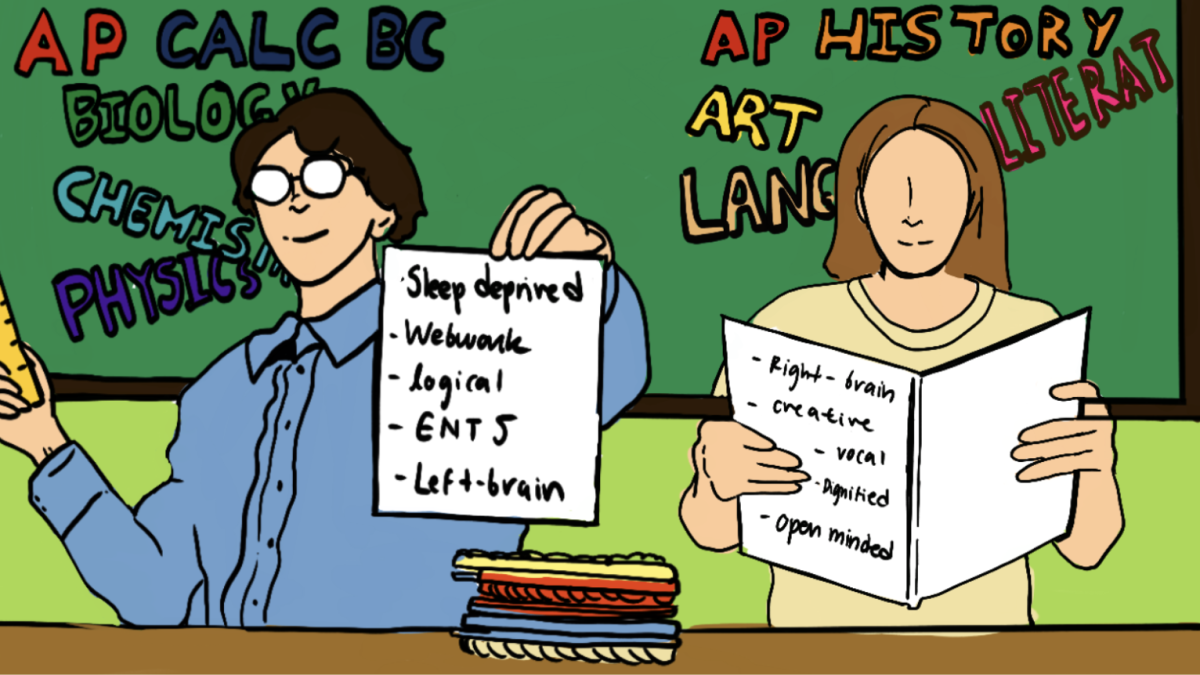
AP courses are typically divided by rigor and curriculum, determining facets such as how equipped you are for STEM subjects versus humanities. But what does the AP course that you take say about your character? Weaknesses? Strengths? It is time to take a break from the persistent test questions and quizzes, and time to listen to your common pool of AP students, and what their courses say about what kind of student they are.
One of the most notorious students are the Calculus BC kids. The immediate stereotype that comes to mind regarding these students includes glasses, a left-centered brain, and an MBTI of INTJ. They master the art of hard-earned rigor that they follow through every hour and second. A minute is never spared for indulging in one’s hobbies; instead, these students satisfy themselves with persistent Webwork orchestrated by the head of the school’s math department: Mr. Warkentin.
“I thought this course was right for my path,” Russell Jin (12), AP Calculus BC student, said. “I always liked to do math. It was my hobby for a long time, and I even enjoy it. Taking this course was a chance to harden my skills into something better. I am not as strict on myself to stick to a stringent schedule that others may think I have, but when it is something I enjoy to do, there is no such thing as a grade.”
Though some stereotypes depict AP Calculus BC students as self-hating yet hardworking teenagers, the reality may be more thwarted than one may think. Like Russell, Calculus BC kids are not inclined to follow a disciplined set of rules that carry out every second of their day. Instead, like most teenagers, they indulge in their passions and hobbies as well, though in their case, those hobbies may involve mathematics and algebra. To each their own!
Centered beside the left-brained students of AP courses are the humanities kids. Students who take courses such as AP World History, AP Language and Composition, and AP Literature are the epitomes of vocal, dignified teenagers. They seek to voice out their creative minds, too large and omniscient to be fully encompassed in a single essay paper.
“I like breaking down the meaning of texts and making discussions with others in courses such as AP Language and Composition,” Sean Kim (12), a student taking AP World History, English Literature, and English Language and Composition student, said. “Finding the exigence below the basis of the words and extracting the purpose is the heart of what we like to do.”
Along the humanities and mathematics departments lies another respected AP course division: sciences. Students who take AP Biology, AP Physics, AP Chemistry, or Environmental Science are seen as logical, open to challenges, and ensure their hypothesis can be proven correct. Their analytical brains are bursting with energy from their knowledge of protons, electrons, and the various particles known to humanity.
“I like looking at the world and seeking aspects that interest me,” Yool Choi (12), AP Biology student, said. “Investigating things that I want to find answers to, analyzing the results, and looking below the surface that others might not be able to pinpoint unless experimentation occurs—these are some activities that I enjoy.”
Contrasting the rigorous environment of science and mathematics are the art students. Students who take AP Art, 3D, or Art History are often sleep-deprived, creative minds that push themselves to the limit to finish their art portfolios on time. It is a constant race against the clock with these students, with only coffee and energy drinks keeping them up at night to finish that one extraordinary stroke on their final pieces.
“We’re pretty bad at time management in my opinion,” Sylvia Lee (12), AP Art student, said. “In the mindset of an artist, we follow our own schedule that matches our habits and our working pace, especially because some pieces take varying different time periods. But I think that’s also a strength of art students—we’re our own breed.”
Every student has their own asset that contributes to the AP course they are taking. Whether you are a mathematical genius who enjoys playing Prodigy, a childhood math game, an open-minded humanities student, an investigative researcher, or an inventive artist, each student embodies a strength and a passion that reflects the AP they are taking. At times, they may seem to fit the stereotype perfectly, but talking to these students reveals that they are not defined by their AP course, but by their curiosity, determination, and work ethic that they bring to it.