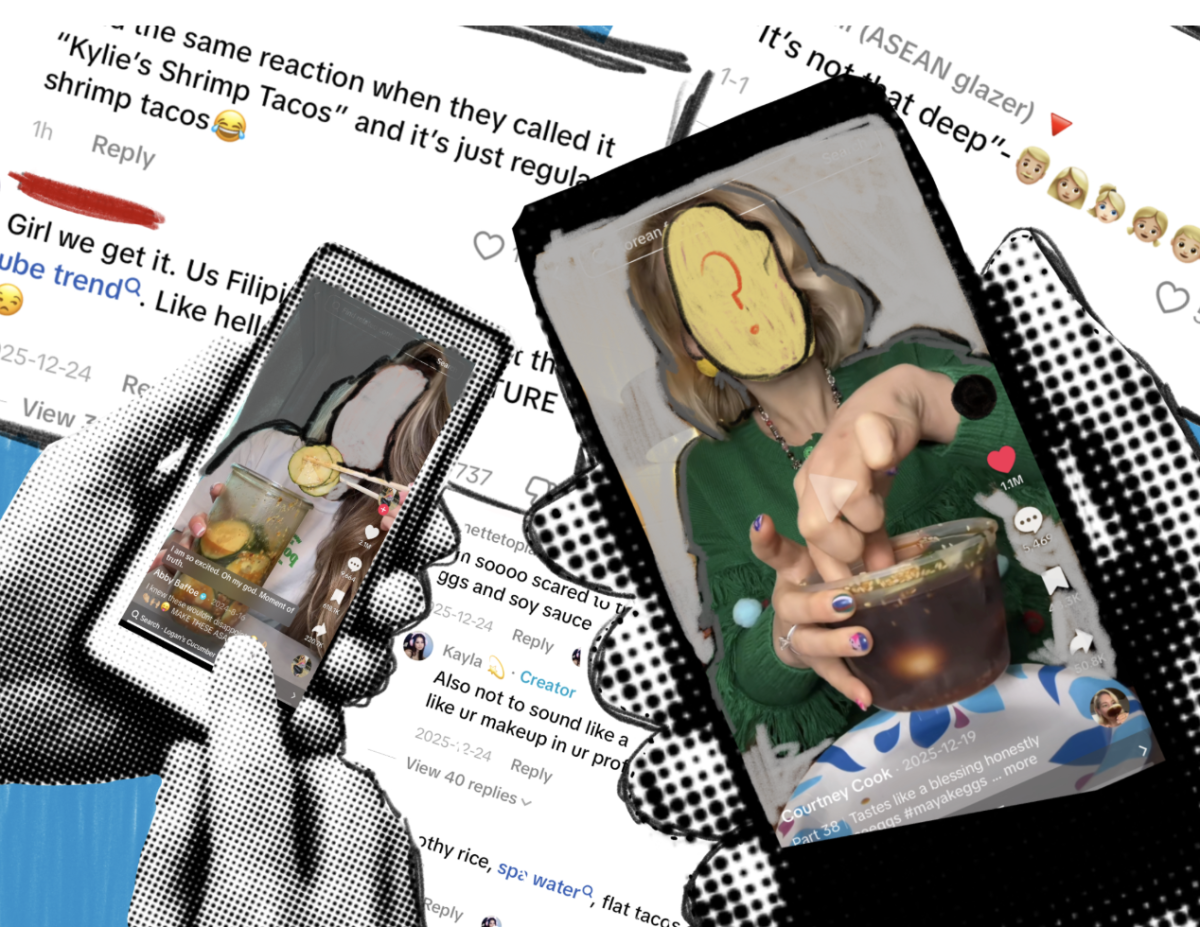
What begins as a harmless mukbang could swiftly lead to something entirely different. For years, mukbang, a Korean livestream featuring eating lots of food, has become popular. But when influencer Courtney Cook uploaded a TikTok video showing her eating Mayak eggs, a Korean soy sauce marinated egg known for its historically budget-friendly dish during the war, an onset of new Western influencers began to hop on the mukbang trend.
Unfortunately, not all responses were praises. The launch of Mayak Eggs pushed foreign influencers to label the traditional side dish as “Courtney Cook Eggs.” Soon, the internet rushed to replicate it, drifting the dish away from its Korean origins. As such, what was once a heritage-rich food soon became an algorithm-friendly aesthetic dish, stripped away from its deeper nuances and renamed for convenience.
The newly “quirky” trend soon received backlash from the Asian community, specifically from other Korean influencers on TikTok who claimed these videos were disrespectful, even for simply labelling the Mayak Eggs as “Courtney Cook’s Soy Sauce Eggs.” Many claimed the importance of professing the cultural origins of this dish, asserting that the backlash is less about the dish, but more about disregarding other cultures.
Other Asian communities, such as the Filipinos and the Chinese, also affirmed that this was not the first time cultural symbols have been renamed due to online ignorance.
Logan’s cucumber salad sparked a whirlwind of mukbangers, garnering positive attention from the general audience to duplicate the savory cucumber dish. However, many have recently begun to realize that the trend was disregarding its original culture. Chinese cucumber salad, which followed the exact recipe that Logan showed on his TikTok page, was another common side dish eaten in China.
Kimchi, a popular and common side dish of Korea, started to be similarly labelled as “spicy cabbage” in the United States. Dishes that amassed popular attention only because they became a viral “trend” in the West have stirred anger and indignation from the Asian community, mainly because, in the past, they were shunned for eating such foods.
“I think it’s great when people try to eat foods that they’re not used to,” Danella Donado, Filipina teacher, said. “But when it doesn’t become okay is when people don’t acknowledge where it comes from and turn it into just a ‘trend.’”
Nowadays, trends change based on how fast likes, reposts, and shares accumulate. Though these trends are the mainstream of entertainment, they’re also an intersection between different cultures. One of the most powerful tools of social media platforms is its ability to share; however, without proper appropriation of each other’s culture, backlash is bound to occur.
Drawing the boundary between overstepping another’s cultural values can be challenging, especially on platforms where self-opinions could construct their own rules. Echo chambers, built to surround social media users with their own biases, can alter one’s perception of other cultures, breaching sensitive topics.
Some users might not even be aware of their own implicit biases, which presents potential anxiety in participating in cultural trends. It poses the question of whether people should even be welcomed in stepping out of their own cultural bubble.
In an era when content creators are exponentially gaining more influence through social media, the line between cultural appropriation and appreciation becomes dangerously thin. When content prioritizes virality over credit, culture soon dissolves under the simple, broad genre of entertainment.
However, not all is lost. Appreciation of one’s culture by simply providing credit to its cultural roots, and showing respect for another’s national dish without having to irk or display disgust, can be internal social manners within the community that can foster healthy foreign relationships beyond just the food.
It was never just about soy sauce eggs, spicy cabbages, or cucumber salads—it is the importance in understanding that another’s culture is not a deduced version of entertainment in the form of a TikTok reel, but a bridge we can use to understand one another’s community.