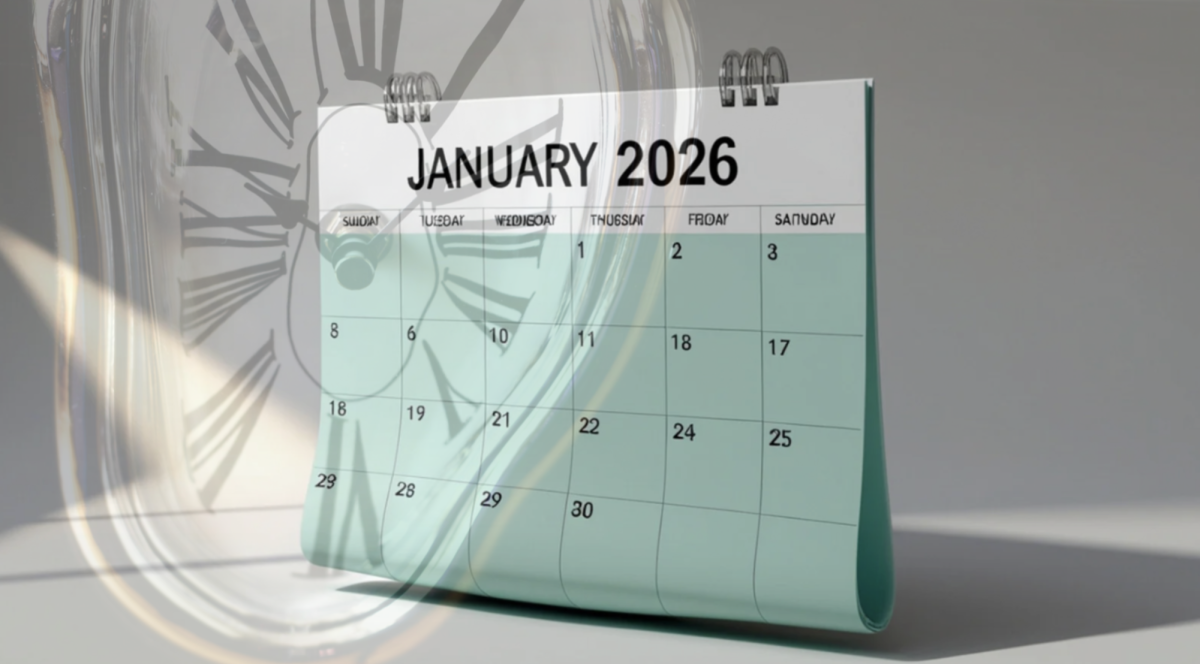
January is a cheerful new beginning to another year… However, for many, it just feels… empty and long, a little too long; out of all the 12 months in the year, January feels off. This is not a coincidence, and there is a sound scientific explanation behind why, to some, January feels so extended and depressing.
“I just feel like January is a relatively bland month,” Selina Lee (10), December holiday enthusiast, said. “There’s not a lot of tests [yet], and I feel like it’s just quite slow compared to the other months. There’s simply not a lot going on in January other than back to school, which frankly I’m not super excited about.”
Notably, one of the greatest potential factors towards our “January depression” can be traced back to December. December is a month full of emotional intensity, packed with holidays, end-of-the-year assignments, accompanying stress, and countless other social and environmental triggers that constantly bombard our psyche. These stimulants cause our body to flood our brain with dopamine, a neurotransmitter linked with reward and anticipation. Constant events in December ensure a sustained high level of dopamine that has the added effect of speeding up internal time perception. When December passes, and January hits, the environmental factors that previously stimulated the secretion of dopamine collapse, resulting in a “dopamine crash.”
Another interesting theory incorporates the “Attention Gate.” The theory states that our brain’s information processing capacity is limited and divided between recording our actions and the local time. A study on the theory reported that our brain only encodes what we focus on, adapting our psychology and internal clock to match it. Applying the finding, during December or previous months, the amount of work and stress present warrants most of our attention, and therefore, time is not properly monitored. Due to time not being monitored, its significance to us is warped or “gated.” However, when January hits, and the stimulus disappears, we no longer have any “actions” or events to focus on. This keeps us in a state of waiting where our minds no longer gate our perception of time, and we start focusing on the weeks, days, and minutes. The disparities in attention and focus are what make January feel so slow.
January is no different from any other ordinary month. However, its unfortunate position following some of the busiest months of the year creates a significant psychological gradient, forcing rapid psychological changes that result in slower perception of time and low motivation. While “slow January” is not a universal phenomenon, it is certainly present in some and is an interesting result of interactions between the brain and its ambient environment.
“January is very conflicting for me because it is both slow and fast,” Elliot Lee (10), student, said. “On one hand, it’s slow because everything feels like it’s taking twice as long; there’s simply not much to do. But also, there’s the new year sprint and ‘I’m going to be different’ this year’s motivations, so in that regard, time goes by fast.