When Ohtani, Japanese baseball superstar of Team Japan, struck out Mike Trout from Team USA, deemed by many as his American counterpart, in the championship round of the 2023 World Baseball Classic (WBC), 42.4 percent of all Japanese households watched. This equates to nearly 64 million people—more than the entire population of South Korea. Hosted by Major League Baseball (MLB) and the World Baseball Softball Confederation (WBSC), the WBC features national teams from 20 countries, with global icons such as Shohei Ohtani, Aaron Judge, Paul Skenes, and Francisco Lindor taking the field to represent their respective nations.
Hosted every three to four years, the last WBC was in 2023, making the event even more anticipated. The event has grown immensely in popularity since its inception in 2006, with the 2023 WBC seeing well over 32 million total views worldwide. It set numerous records, including the highest registered viewers for the First Round, drawing over 1,010,999 spectators. For context, this only counted in-stadium viewers, averaging 25,275 for the 40 first-round games of stadiums with holding anywhere between 13,000 and 50,000 visitors.
This was a significant 24 percent increase from the average 20,402 attending first rounds in the 2017 WBC. Field-specific records were also set, with LoanDepot Park hosting over 71,289 viewers and Chase Field drawing 47,534 viewers, shattering its historical record with 68,147 viewers over the course of two games.
“I’m an American, so I am rooting for the US,” Christopher Van Swol, an avid baseball enthusiast, said. “I’m a Brewers fan, and even though they’re not playing in the WBC, the Brewers’ players are playing here and there, like Bryace Turing for the USA, so I’m cheering them. But at its core, baseball is a chaotic game, and I could see any team having a fair chance at the championship.”
The primary and most accessible method of prediction is the World Baseball Classic Odds 2026. The system works much like a betting system, in which the team with the least gains is often cited as the “safest” or “most likely” team. If the numbers are to be believed, then WBC 2026 should be a win for Team USA as they take the lead with a score of +160. They are followed by Japan and the Dominican Republic at +290 and +425, respectively, translating to 38.5 percent, 25.6 percent, and 19.0 percent chances of winning for each team.
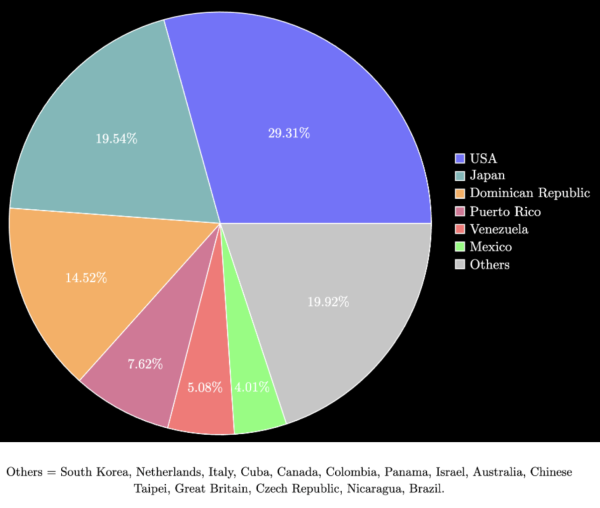
However, Mr. Van Swol’s claim that any team could have a fair chance in the championship regardless of ranking is not an understatement. Numbers don’t lie, but they also don’t tell the full story. In the 2006 WBC, South Korea had around a 2.8% of winning the championship. However, they overturned the prediction with a surprising underdog performance, beating Japan, the tournament favorite, twice. Despite a new, more favorable probability of reaching the championship, they failed to advance and finished 3rd place.
These twists and turns are visible not only through the WBC but also in baseball as a whole. For example, a game between the LA Dodgers and Toronto Blue Jays saw betting odds of -149 and +122, respectively. This made the Dodgers 14.2% more likely than the Blue Jays to win the game, a significant difference. In this case, the Blue Jays would be considered the underdog.
While the Blue Jays lost this game, other teams have better records when the odds are stacked against them. The San Diego Padres have a 53.2 percent win rate as the underdog, and the Houston Astros won 53.3 percent of the time as an underdog. The point to prove is that for baseball, simple betting odds don’t do justice to real-life results. Countless X factors, modifiers, and variables cannot be crammed into one equation to produce a single definite result. This is the nature of baseball, and while it may be fun to indulge in these probabilities and numbers, they are, in the end, only one part of the equation, and the other half is measured out on the field.