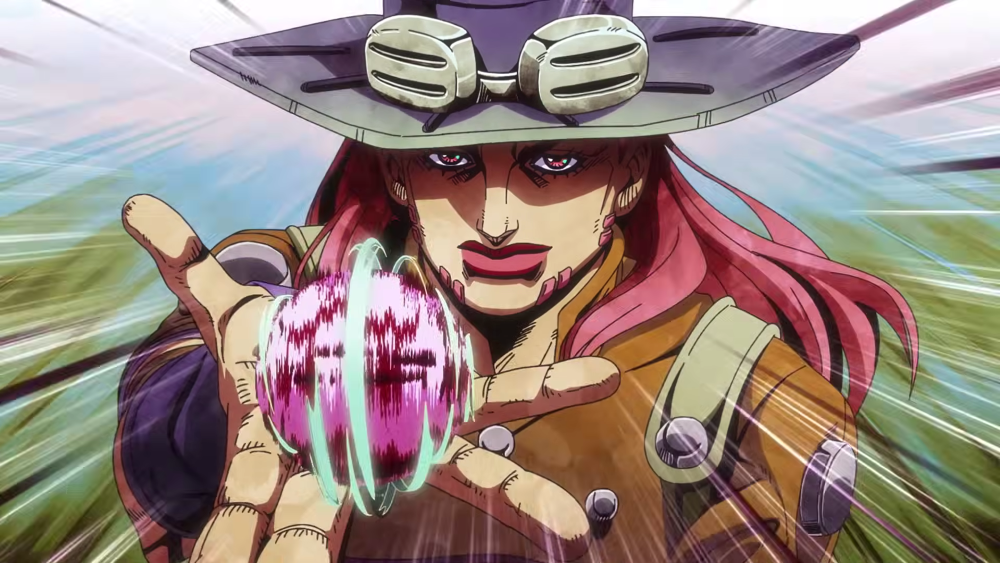
Ever heard of a jaded biracial teenager with an oddly herculean stature traversing the Middle East for 50 days in search of a demonic 19th-century vampire? What about said vampire’s son with an absurdly fatuous hairstyle tackling Italy’s greatest mafia boss? Now how about a paraplegic ex-equestrian prodigy and an inscrutable cowboy in possession of green spinning balls collecting parts of Jesus’s corpse on a transcontinental horseback race?
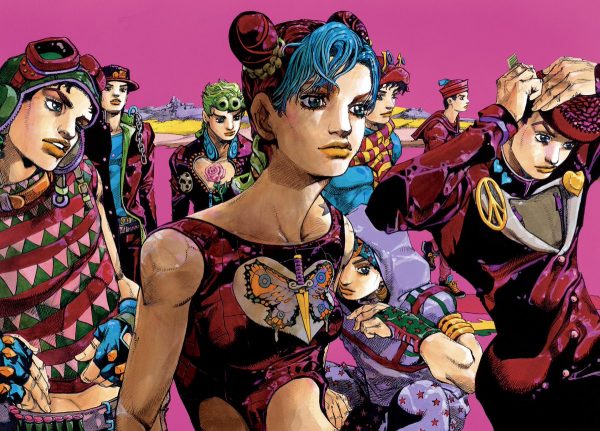 (Source: Twitter)
Welcome to the world of JoJo’s Bizarre Adventure.
Regarded as one of the most intricately creative manga/anime series of all time, JoJo’s Bizarre Adventure is truly one of a kind. Its unorthodox play on color theory, eccentric plotlines, and of course, its hilarious memes allure fans worldwide. Now, animation studio David Productions has released the animated adaptation of the seventh installment of the series, Steel Ball Run, and its first episode aired on Netflix on March 19. Unsurprisingly, it is nothing short of fabulous.
Upon 24 hours of its release, Steel Ball Run shattered numerous records, receiving a 9.9/10 rating on IMDb and surpassing ‘Frieren’ as the no. 1 rated Japanese anime series on MyAnimeList. The first episode titled ‘Steel Ball Run’ saw immense popularity; fans of ‘Frieren’ and other top anime series alike have begun “review-bombing,” or purposely marking low scores on the new episode to keep their favorite show at the top of the leaderboard (unfortunately, the review bombs were somewhat successful—the show stands at no. 2 currently, yare yare). The long-awaited season marks David Productions’ return from a 3-year hiatus since their last release of the sixth season, Stone Ocean, in Dec. 2022, with the 48-minute episode having garnered an unprecedented amount of attention from the anime community.
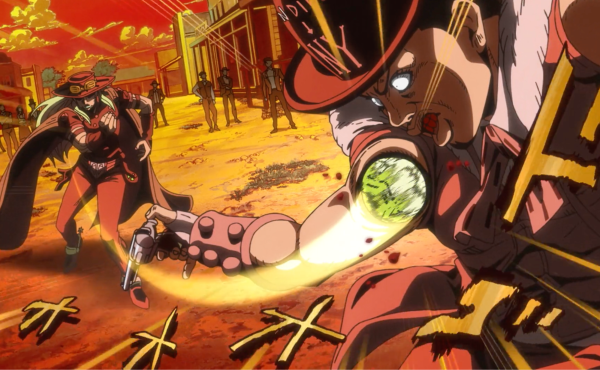
The start of Steel Ball Run takes place in 1890, San Diego, in a Wild West setting. The episode opens with a fiery chase between a group of Native Americans and a rebellious tribal member with extraordinary running power who we later come to know as ‘Sandman.’
 (Source: Netflix)
The story soon introduces the deuteragonist (in the JoJo community, they are commonly referred to as the ‘Jobros’), Gyro Zeppeli. He is an enigmatic figure with a keen mastery of spinning balls, his versatile weapon used to shamefully kill a sly criminal who attempts to steal his participation fee for the upcoming horseback race, the Steel Ball Run. The story’s protagonist, Johnny Joestar, a former jockey who paralyzed his lower body in a street fight, is obsessively interested in Zeppeli’s green spheres, and later proceeds to join the Steel Ball Run to discover the mystery shrouded within them. The story briefly introduces some key characters: Pocoloco, a scatterbrained fool with miraculous luck; Urmd Avdol, Diego Brando, etc.
 (Source: Netflix)
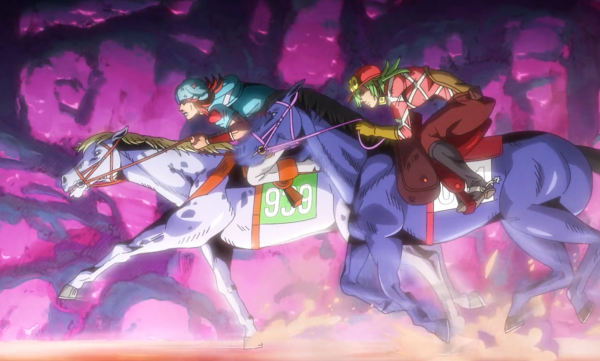
During the race, the episode flaunts some otherworldly, absolutely incredible color play during combat scenes between Diego, Johnny, Gyro, Pocoloco and Sandman. David Productions undoubtedly paid extra attention to detail to stir energy in these scenes during the race, using unconventional color schemes and natural dialogue between characters that does not supersede the plot’s tension. To add to the suspense, the entire race is commentated by an unseen narrator, truly immersing the viewer into what seems like an actual equestrian race.
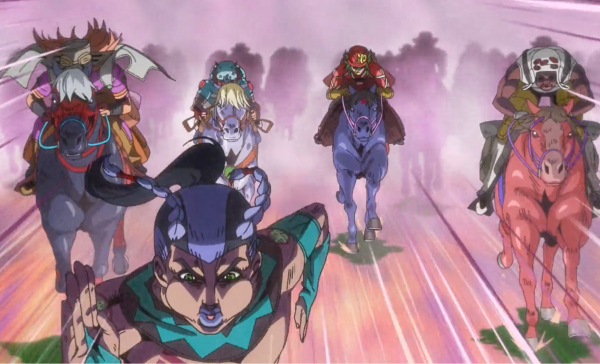 (Source: Netflix)
What is so flawless about this first episode is the production team’s pristine work with the pacing. The studio did omit some plotlines like Sandman’s origins as an insurgent against his tribe alongside other minute details, but it definitely made for a faster-paced watch that led up to the race. After all, David Productions was very strategic with ensuring that viewers get to the action during the race with minimal delay. The studio also did an impeccable job with diversifying their frames and motion shots—scenes never felt redundant, and it truly made for a dynamic, flowing piece of art that kept viewers on the edge of their seats.
Steel Ball Run is fascinating in that it is so ahead of its time. In fact, Araki wrote the original manga from early 2004 to 2011, published in the weekly Shonen Jump and Ultra Jump in a total of 24 volumes. Following some of his greatest storytelling from Golden Wind (Part 5) and Stone Ocean (Part 6), Araki experimented with a fresh start in a 1800s race setting with Steel Ball Run. It is apparent, not only from the multilayered storytelling and exceptional artwork, but also emotional character development, that Steel Ball Run is arguably one of Araki’s greatest works.
With only one released out of an estimated 40+ episodes, JoJo fans have a lot to look forward to in the coming months. Netflix has not officially announced the show’s format for episode releases, whether in batches or weekly episodes, but speculation around a deleted TikTok comment from Netflix Chile’s account confirming a weekly episode schedule has sparked further discussion surrounding the show’s release.
But one thing is for certain. Better days are coming with JoJo.