Every year, National History Day (NHD) is full of trepidation as participants await the final results around the SIS building. In order to remedy this period of boredom, various events were held around the school for these individuals to participate in. In particular, History Honor Society (HHS) hosted two events: the annual history bowl tournaments and the new traditional Korean game competition.
HHS held the history bowl competition from 2-3:30 p.m. in the atrium. It has been a long-standing tradition of HHS to host history bowl competitions at NHD, as it is one of the club’s prominent activities. By hosting tournaments at NHD, participants were not only able to get a sense of the activities HHS engages in, but also interact with participants across different competition categories and grade levels.
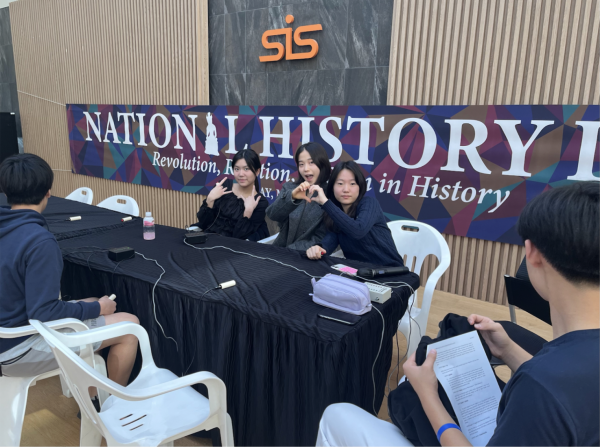
The rules are simple: two teams compete against each other in four rounds, answering complex history trivia. The goal is simple: outcompete the opposing team by answering questions at the speed of light with precision. HHS members helped facilitate the tournaments by setting up buzzers, reading question packets, and score-keeping, as well as participating in the actual rounds.
“I feel like it was good that we got set up pretty quickly,” Raisen Qi (10), history bowl facilitator, said. “We knew where our resources were, how we should set up, and Mr. Van Swol was also there to help.”
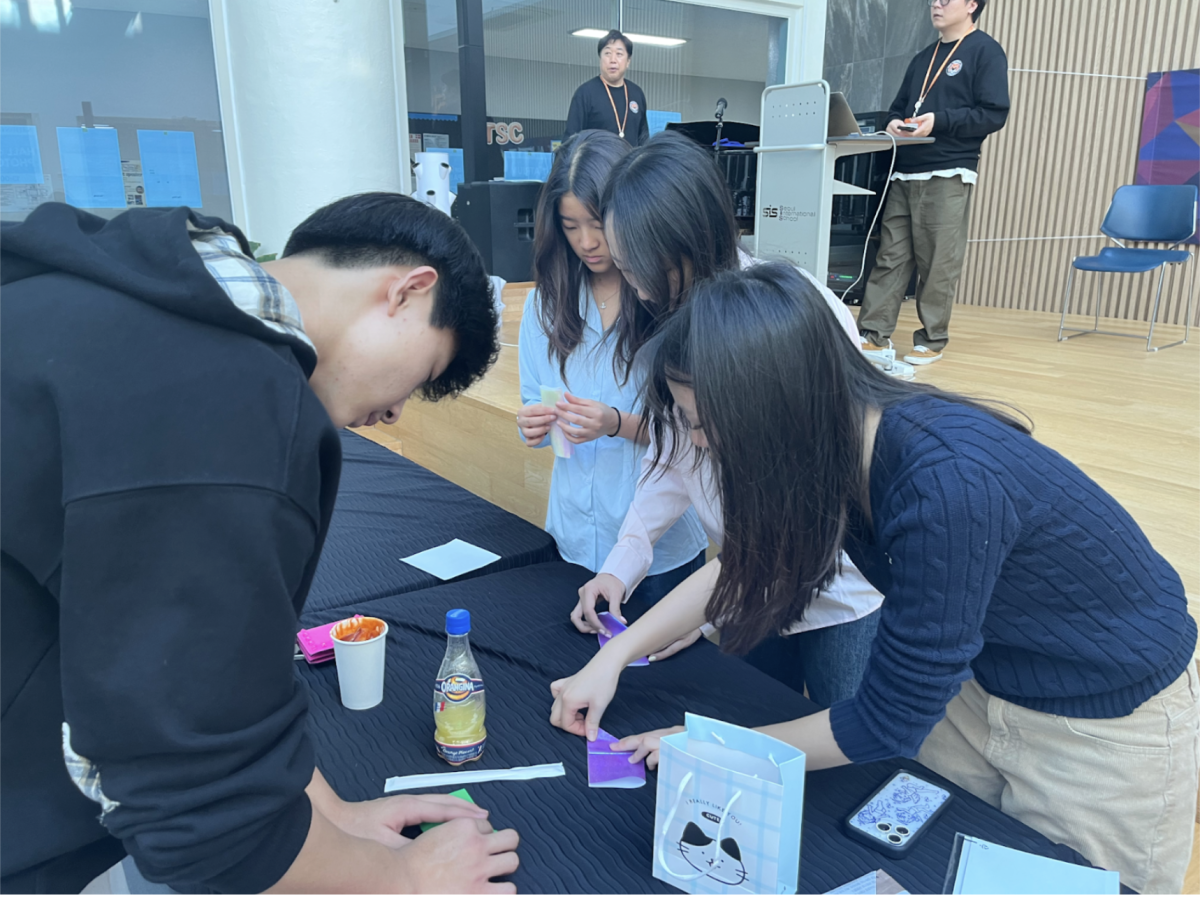
From 4-4:45 p.m. in the Atrium, HHS hosted the Traditional Korean Games tournament. Participants created ddakji and played the game of ddakji-chigi, a historical pastime where individuals win by slamming (chigi) their paper square (ddakji) on the ground in pursuit of flipping the opponent’s ddakji.
“I was taking Asian Studies, and Ms. Nam told me about the importance of these cultural traditions, or being part of your Korean identity,” Carson Park (12), HHS vice president, said. “One surprising thing is that most of these kids do not actually know how to fold ddakji, which is surprising because [despite the rising popularity of] international films like Squid Game, Koreans do not actually know how to play Korean games.”
The new initiative began as a way to introduce Korean culture to many participants who, despite being ethnically Korean, are unfamiliar with Korean history as a result of attending an international school. As NHD is an occasion where students from schools across Korea present their own projects to contribute to historical research, the Traditional Korean Games tournament also served as an avenue for HHS to present a piece of this endeavor.
HHS members demonstrated how to fold ddakjis out of colored paper at the occasion, and engaged with participants as they created and played with the ddakjis.
“I think it was a good opportunity for me, as I prepared for that activity, to endorse myself with my roots,” Alina Lee (11), ddakji event organizer, said. “I thought it was a very wholesome event.”
However, HHS faced some major challenges in running the event, especially regarding communication with participants. Locations of the events changed throughout the competition, which made it difficult for both participants and organizers to keep track. As a result, HHS has some difficulty getting participants.
“I think better communication with the student council could help run the event more smoothly,” Raisen said. “Because [for the] history bowl, some of the students that participated in NHD that wanted to do the history bowl didn’t get the opportunity due to a miscommunication.”
Ultimately, the event was a way for HHS to contribute meaningfully to the international school community, providing entertainment through familiar tournaments like the history bow and exhibiting traditional Korean culture.