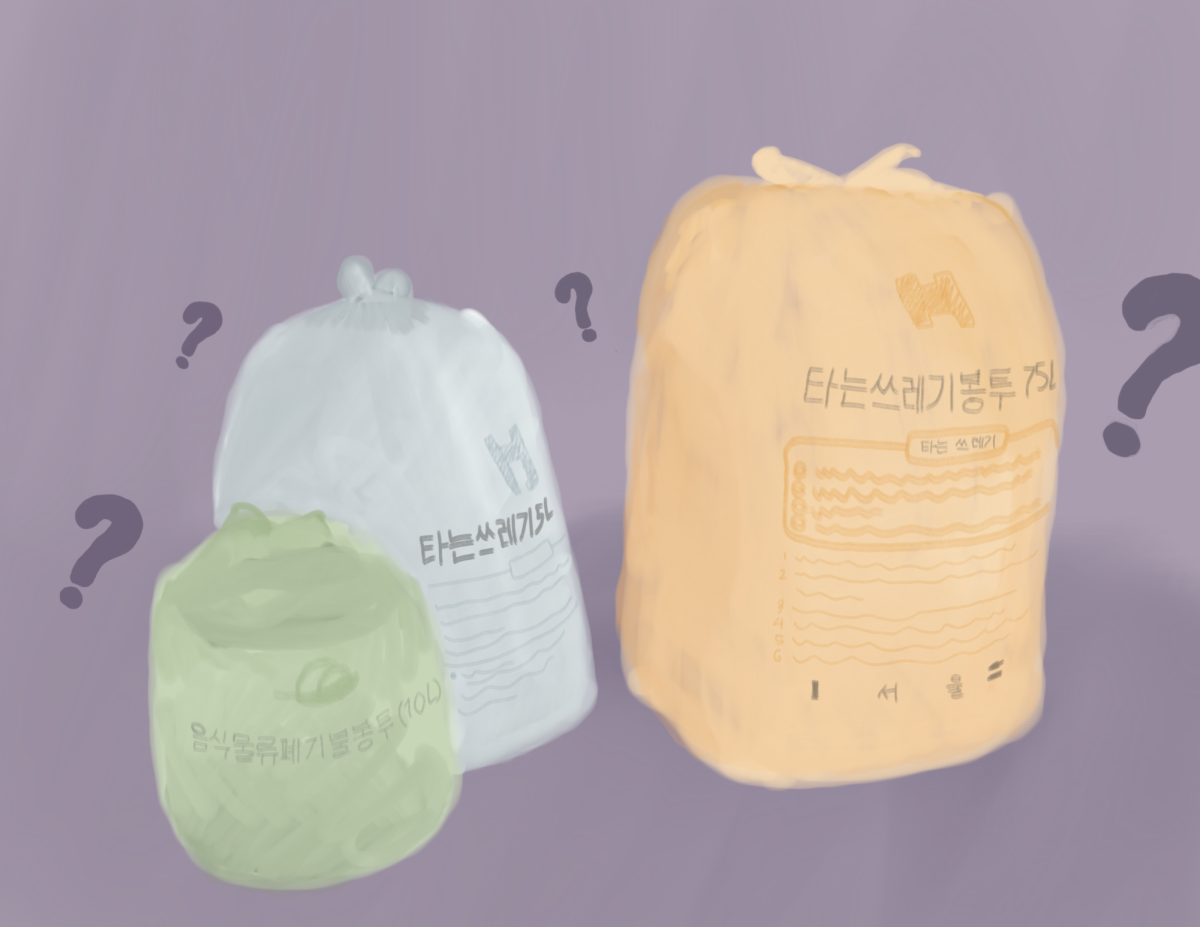
Since March, Korea has been hit with a peculiar phenomenon: the trash bags are gone. News outlets started reporting people purchasing excessive amounts of disposable trash bags, and stores even putting limits on the number of bags one could purchase. Trash bags, once the most common items in shops, are now being treated as treasure.
But why are Koreans suddenly hoarding, out of everything, trash bags?
The answer lies in chemistry. Plastic bags are made from napthal, a chemical made when petroleum is heated and refined. This makes fossil fuels crucial to the manufacturing of plastic and vinyl products. Despite its importance, Korea heavily relies on foreign imports for fossil fuels, importing 72 percent of crude oil from the Middle East.
“It is a very bad economic implication, the fact that we cannot access oil, because Korea doesn’t have any natural resources,” Joseph Kang (11), politics enthusiast, said. “I think the access to oil allows for things like manufacturing. Basically all the industries in our economy are relying on a lot of natural resources in the world. The lack of oil is probably going to lead to a very big economic instability in the next few years.”
The recent conflict in the Middle East was especially compromising for Korea, as the Strait of Hormuz—the waterway in which Korea imports 40-45 percent of its oil through—was shut down due to safety concerns. Many people became concerned that the inability to import oil would cause a strain on domestic oil production and lead to a skyrocketing oil price. Many feared that trash bags—a fundamental material for disposing trash—would become unaffordable due to high oil prices.
Among the criticism for the crisis was the fact that it was entirely avoidable. According to JoongAng News, existing technology to create plastic bags out of renewable resources had not been widely implemented due to the inability of municipalities to implement it, and because bags made of naphthal were more durable.
“My guess is the reason why they still make plastic bags is because they are cheaper than any alternative,” Dale Fiess, AP Environmental Science teacher, said. “People are not going to want to pay off a lot of money for a trash bag. [It is also a problem that] if you switch to all sustainable bags, the material is coming from something living. So you are damaging and taking resources away from nature or food to do that.”
Eventually, this psychological crisis escalated into a phenomenon known as “panic buying,” which refers to when individuals hoard items in fear of an impending crisis, rather than when the crisis has actually occurred. “Panic buying” has occurred multiple times throughout history, whether it was during the mass bank withdrawals during the 1929 Stock Market Crash, or toilet paper and face masks going out of stock during COVID-19.
However, many argued that this approach was excessive, criticizing the media for magnifying the issue of not being able to import oil. As news outlets reported potential effects of the trade barrier, audiences became encapsulated in the fear of basic items going out of stock.
“I think there is truth to [the trash bag shortage], but it is kind of exaggerated, especially with social media,” Michael Byun (11), social media user, said. “I always see people going to convenience stores and asking for the big trash bags. I think [the panic buying] is just because people keep doing that and buying it. It is like the toilet paper thing all over during COVID.”
As times of crisis like this one can arrive at any time, the Korean government should focus on regulating the stock and prices of basic items, so that shortage hysteria does not become widespread. After all, “panic buying” is not a long-term solution.