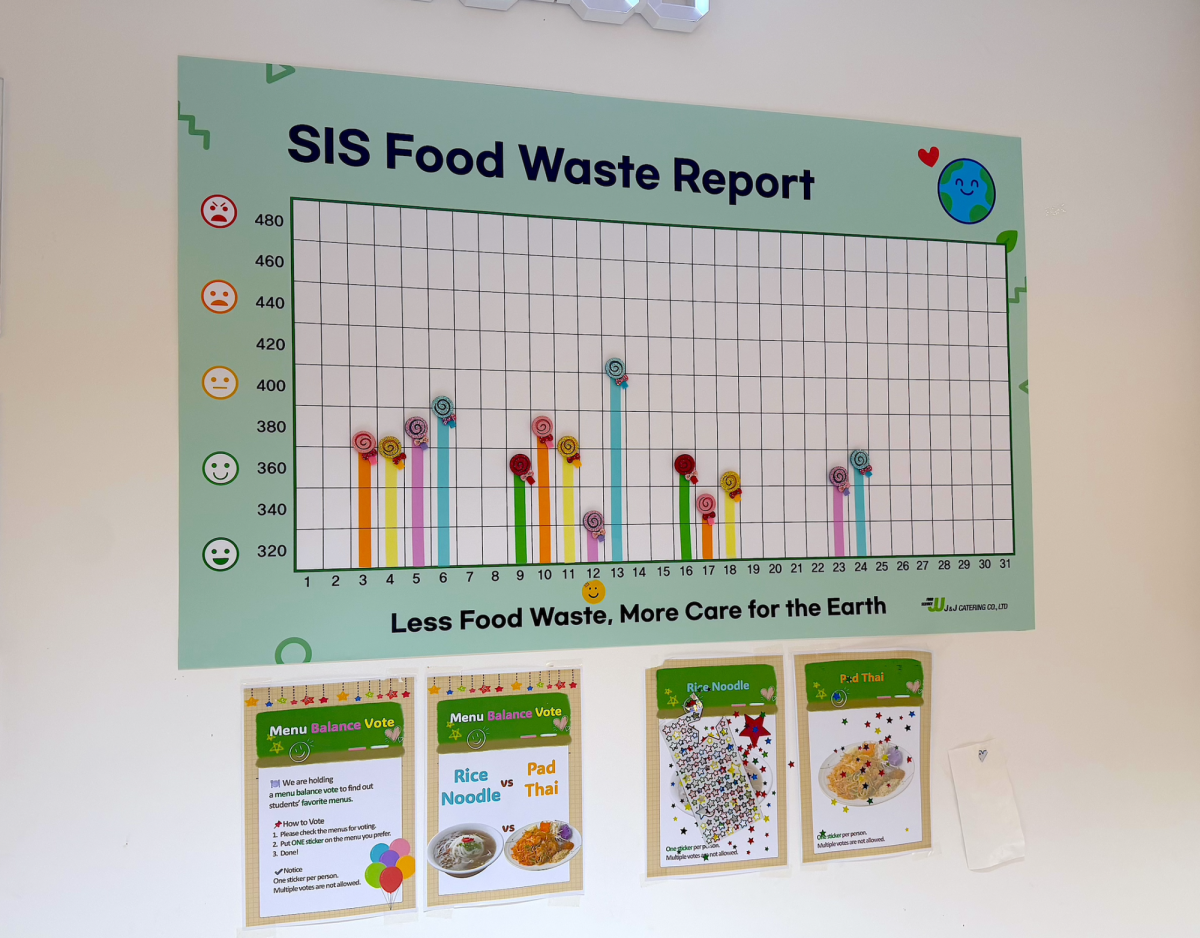
Every lunch period, SIS students pile their trays as they leave behind surprising amounts of food. To combat this problem, J&J Catering launched a food waste report board in the cafeteria on March 3, expanding the initiative they have already begun in other partnering international schools. By displaying the exact volume of food waste SIS produces each day, the initiative aims to raise students’ awareness of their consumption habits.
“It is good if food waste decreases; there is the environmental side, but also the cost side,” Choi Jung Min, manager of the initiative, said. “If students can visually see how much waste we produce, and how much the initiatives actually help, we thought it would be more effective because the issue will feel more tangible.”
Measuring the exact volume, however, is easier said than done. Each day, the SIS community produces hundreds of liters of food waste, making it a demanding task for staff to sort through and estimate the volume of leftovers on a daily basis.
“Because waste is discarded into large bins rather than bags, precise measurement is difficult,” Ms. Choi said. “We rely on container capacity as a reference point, so we measure the volume by looking at how many bins were filled and how much of the bins were filled.”
As for impact, Ms. Choi says it is still too early to identify a clear downward trend, but student engagement has already increased visibly. For younger students in elementary and middle school, the visual display appears more effective at changing their perceptions of the food waste they produce every day. However, some students argue that awareness alone may not be enough to drive meaningful behavioral change.
“To be honest, the report board has not made a visible difference in students’ consumption habits, at least for the peers I see around,” Yuna Ahn (9), cafeteria user, said. “The board is a great reminder of the specific volume of food waste produced, but this does not necessarily urge them strongly enough to take immediate action. I personally believe that the menu surveys that J&J Catering promotes are more important because it tackles a more fundamental cause of food waste.”
Student preference, after all, is another key factor that the board alone cannot address. A menu students dislike will always generate more waste than one they are excited about, no matter how many reminders the boards tell them to finish their plates. Acknowledging this, J&J catering displayed a poster titled “menu balance vote,” which lets students vote for their favorite menu between two options by placing a sticker on the food image. This new initiative, along with the monthly food satisfaction surveys that have been consistently distributed for years, creates synergy by combining awareness efforts with direct student input on menu choices.
The board’s impact, it seems, is rippling beyond the cafeteria, driving strong momentum among groups working toward the same vision of environmental preservation. For some students, seeing the numbers on public display was a call to action.
“Based on J&J Catering’s data, we calculated that about 48 percent of all the food we eat is being wasted,” Hannah Park (11), President of Environmental Preservation Project (EPP) club, said. “We felt that just displaying the numbers was not enough. So our club recently purchased a compost machine with our own funds to process the leftover food waste into fertile soil.”
EPP plans to donate to the science department for use in the school garden, turning what was once considered waste into a resource for future learning. The club also shared the data on Instagram to spread awareness beyond the cafeteria walls, extending the conversation to students who might never have glanced at the board twice.
What is perhaps most notable is not the board itself, but the chain of events it set into motion. Small as it may seem, a chart on a cafeteria wall was enough to spark actions that its creators never anticipated. Whether the initiative will lead to a measurable reduction in food waste remains to be seen, but the early signs suggest that visibility alone can be a powerful first step.